

You have an interview on Thursday
Attach the job to the conversation first — a round will not start without one — then pick a round and practice by typing or out loud. Ends with a summary you can act on.
On this page
You have a real interview coming and you want to rehearse for it rather than read about it. ATSReady runs mock interview rounds inside chat: it asks, you answer, and at the end you get something you can act on.
The path has one move that decides how useful the whole thing is, and it happens before you start.
Attach the job before you start
A mock interview is grounded in two things: your own record, and the job attached to the conversation you are in. Attach the posting first, and the questions are about that posting. Skip it, and the round does not start: you are asked which job to rehearse against instead.
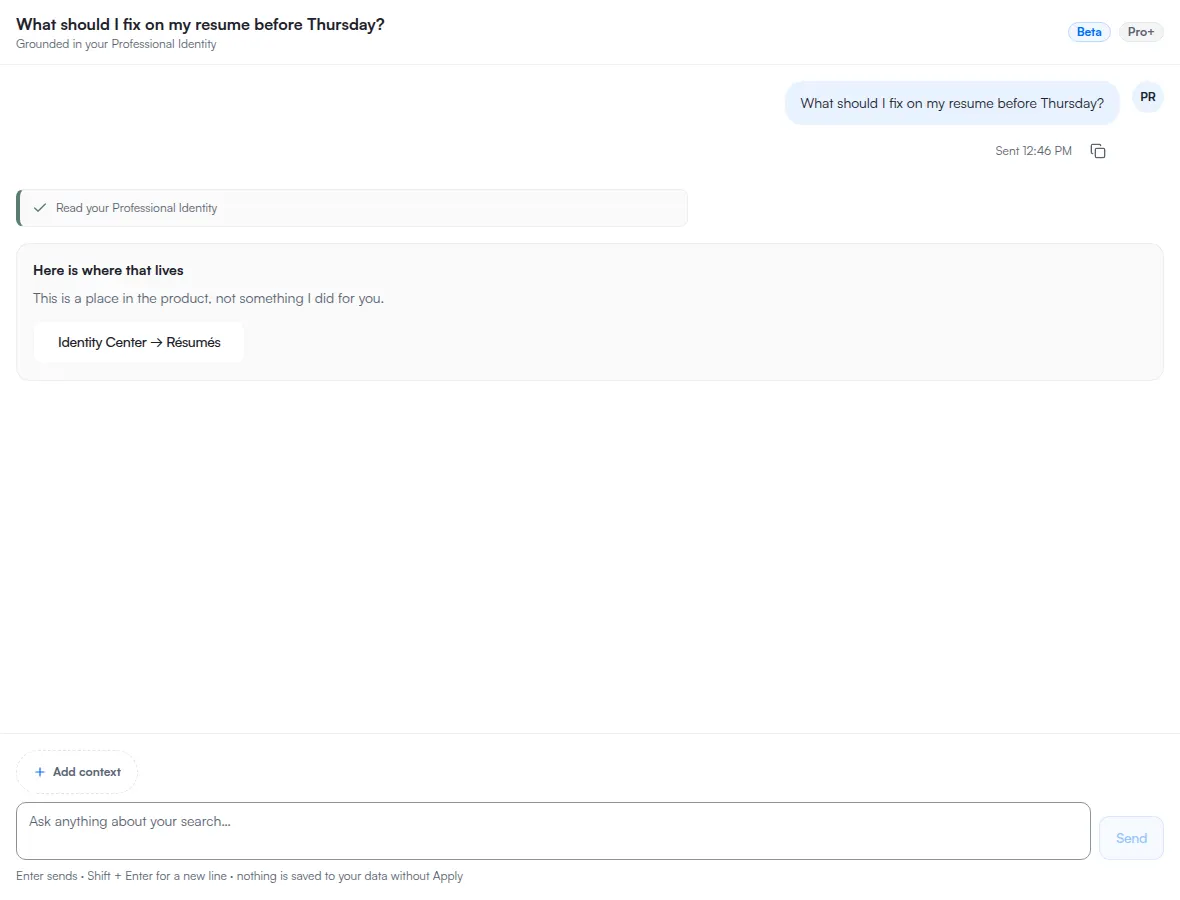
This is the part worth being precise about, because the product will not start a round without a job: it answers with a prompt to attach one — Which job should this round rehearse against? — and a list of your open applications, rather than with a question. Once a round is running, the line at the top of it reads Rehearsing against the job attached to this conversation, and the job's chip above the message box names which posting that is.
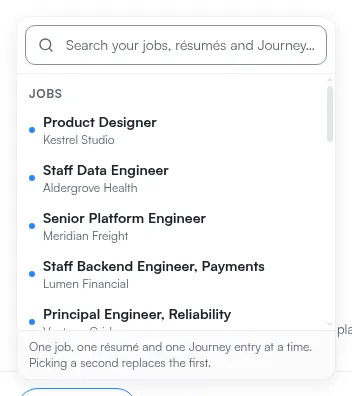
Read that chip before you answer anything: if you have more than one posting saved, make sure it names the one for Thursday. A round against the wrong posting is not preparation for Thursday, and the difference is invisible in the questions themselves until you notice they never mention the role.
If the posting is not in ATSReady yet, put it there first — Add a job and Save a job with the extension are the two routes, and You found a job and want to know if it is worth it is the walkthrough for deciding whether to bother. If you also want to know what the organisation is like before you rehearse against it, Company research is the other half of the same preparation.
Which round to pick
The picker is titled Pick a round and offers four, each rehearsing a different thing:
- Behavioural — Situations from your own history, not hypotheticals.
- Technical — The craft on your résumé, in depth.
- Situational — Judgement calls, put to you as hypotheticals.
- Closing — The questions you would ask, and how a round ends.
They are not a difficulty ladder and you are not expected to run all four. Pick the one that matches the stage you are actually at. A first-round screen is usually behavioural; a panel with the team you would join is usually technical; a final conversation with a hiring manager is usually the last two. If you genuinely do not know which it is, ask the recruiter — that is a better use of the day than rehearsing the wrong shape.
Each round has a cap on how many questions it will ask, and the cap depends on your plan. Chat limits is the canonical page for that and for every other limit chat holds, and Mock interviews describes the rounds themselves. Neither figure is repeated here, because they move and this page would be the copy that goes stale.
Typing or out loud
A round can be answered by typing or by speaking, and the choice is worth making on grounds other than convenience.
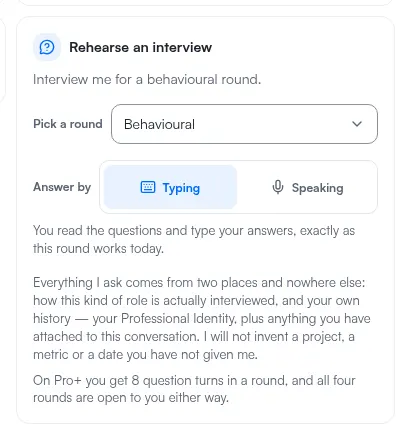
Typing lets you draft. You can rewrite an answer three times before you send it, which is useful for working out what you want to say and useless for practising saying it. Speaking removes the draft, which is exactly the pressure the real thing applies: you find out where you trail off, where you circle back, and where you have no ending prepared.
The composer says what it does under it: Enter sends · Shift + Enter for a new line · nothing is saved to your data without Apply. Send submits the turn and Stop cancels one in flight without ending the round.
Voice is not available on every plan. Where it is not, the round runs as text and nothing else about it changes; What each plan includes is the tier reference and Why something is locked is the page for working out which kind of block you are looking at. Even where voice is available, a connection can fail to establish — in which case the round does not die with it. It falls back with Connecting stopped. This round carries on as text — type your answers in the box below., and the placeholder in the composer changes to Type instead of speaking. The fallback is deliberate: losing a connection mid-preparation should cost you the microphone, not the rehearsal.
What happens when a round ends
A round ends in one of two ways. It reaches its cap, and the counter in the header tells you where you are as you go. Or you end it early with End interview, which is a legitimate move rather than a failure — a round you have stopped learning from is worth ending.
Ending is not deleting. The thread stays. You can read back through every question and every answer you gave, which is the part most people skip and the part that is actually worth the time: the value is rarely in the last answer, it is in seeing that three of your answers had no result in them.
What the summary is for
The summary at the end is a reading of how the round went, and it is meant to be acted on rather than filed.
It is worth being clear about what it is not. It is not a score to compare against anyone, it is not a prediction of Thursday, and it is not a change to your record. Chat drafts; it does not write. Anything chat proposes to put into your account — a journey entry, a resume edit, a note against the job — is proposed as a card that you approve separately, and until you approve it nothing has been written. Review chat changes before you apply them covers that step and why it can refuse.
The strongest use of a summary is to take one concrete thing from it into your record rather than into your memory. If a behavioural round showed that an example you rely on has no measurable result attached, the fix is not to remember to say it better on Thursday — it is to go and write down what the result actually was, where it becomes available to everything else the product does. What chat can do lists the actions available from the same conversation.
If it is rehearsing against nothing
The symptom is a round whose questions could have been asked of anybody: no reference to the role, no reference to the organisation, nothing drawn from the posting.
Check the header line first. If it reads No job attached to this conversation yet, the job was removed after the round started, and that is the answer. Attaching applies to the conversation, so end the round and start again in a conversation that has the job attached, rather than attaching mid-round and hoping the next question improves. If the chip names a different posting from Thursday's, the fix is the same.
If the job is attached and the questions are still generic, the other input is thin. Rounds draw on your own record as well as on the posting, and an account whose Professional Identity holds very little gives the questions very little to be specific about. Filling in the record is the fix, and it improves considerably more than the rehearsal — You did something at work and want it on record is where that starts.